
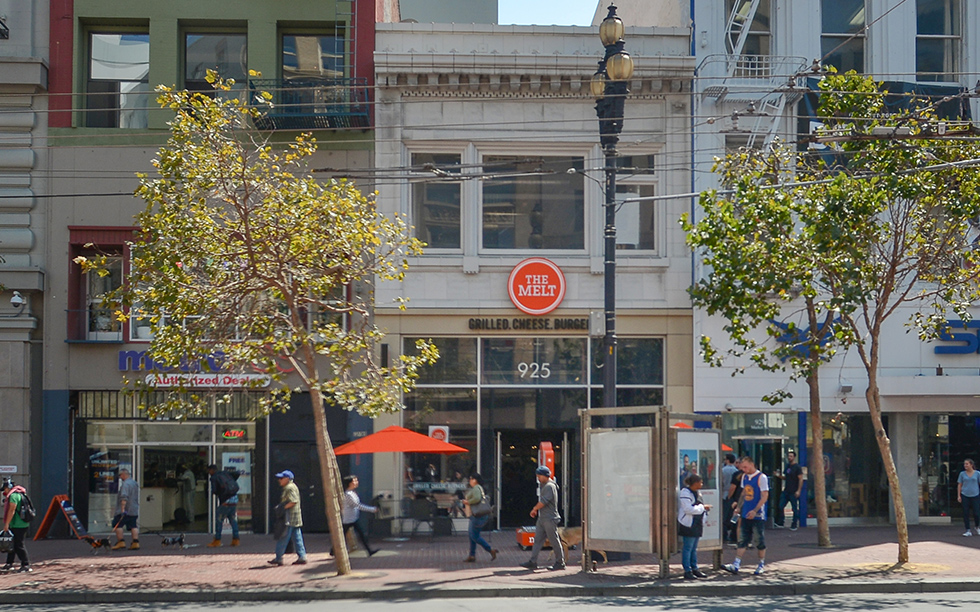
Most fast-casual brands treat third-party delivery as a necessary evil; a channel that dilutes margins, damages brand perception, and creates more problems than it solves. The Melt has taken a different approach. Roughly 40 percent of the brand’s sales now flow through delivery, and at its highest-performing restaurants the number climbs even higher. One location near Stanford University generated more than $6.1 million in annual sales, with nearly 40 percent of that volume coming from delivery alone.
CEO Ralph Bower did not set out to become a delivery specialist. In fact, he initially fought the idea.
When team members first approached him about testing third-party platforms around 2017, Bower’s response was blunt. He worried the food would travel poorly and that the economics would never work. “I said absolutely not,” he has recalled. “We’re going to deliver substandard food and not make any money at it.” His team persisted. Bower eventually agreed to a limited test. The early results were modest, just 3 to 4 percent of sales, but enough to expand the experiment. By the time COVID hit, delivery had grown to nearly 20 percent of sales. During the height of the pandemic it spiked dramatically. Today it has settled at approximately 40 percent systemwide, a figure that has become a durable and profitable part of the model rather than a temporary pandemic artifact.
Bower credits the outcome to a simple principle that has defined his tenure: listening. “If I hadn’t listened to my team members and taken their advice despite my better instincts, we wouldn’t be where we are today,” he has said.
That same philosophy underpins the cultural foundation of the brand. Shortly after Bower joined The Melt in 2016, a guest left a Yelp review at the Stanford restaurant that simply read, “I love it here.” The three-word phrase stuck. Bower and his leadership team tore up existing mission and vision statements and replaced them with a single operating standard: deliver an “I Love It Here” experience to every guest. The company still rallies teams around the concept twice a day. There is no long list of corporate values. There is one.
Bower believes that standard is what makes delivery work at The Melt when it fails elsewhere. Order accuracy, packaging, and consistency are not treated as secondary concerns. They are measured against the same “I Love It Here” filter applied to dine-in guests. The food itself was engineered with travel in mind: melted cheese that holds, burgers built for structure, and a focused menu that reduces complexity in the kitchen. The result is a delivery experience that guests appear willing to reorder.
The numbers reflect the discipline. Company-owned restaurants open more than a year average $3.4 million in annual sales. The top third of the system exceeds $5 million. Prime costs sit at 55.1 percent. The footprint is compact, typically 1,900 to 2,300 square feet, which keeps occupancy and labor in check even as off-premise volume grows. Late-night sales, often 38 to 40 percent of the day after 8 p.m., further balance the revenue mix.
For multi-unit operators evaluating concepts in 2026, the combination is unusual. And The Melt doesn’t even keep it a secret. They are one of the most transparent emerging brands to come around in years. The Melt discloses just about everything you would want to know with one of the most comprehensive Item 19’s in the industry. The Melt even publishes transparent results on their franchising website at www.meltfranchising.com. It’s worth a look. Most burger brands still live and die by traditional lunch and early dinner windows. The Melt has demonstrated that a high percentage of delivery and late-night business can coexist with strong unit economics when the operating culture and food quality are tightly controlled.
Bower is clear-eyed about what the brand is…and is not…seeking in franchise partners. “The only people we want at The Melt are those who get excited about delivering an ‘I Love It Here’ experience,” he has said. “If you can’t be fanatical about that, it’s not a fit.” The company is opening franchising selectively, prioritizing proven multi-unit operators who already understand high-volume execution and are willing to protect the culture that has driven the results.
In an industry where delivery is often viewed as a margin drain, The Melt has treated it as a growth engine. The difference, according to Bower, comes down to the same principle that reshaped the brand a decade ago: in order to be a “Great Restaurant Company” you need two things, 1) Great Food; and 2) high uncompromising standards around running “Great Restaurants. This same principle is in every action that makes the food extraordinary, aligns the entire team around a single guest standard, and refusing to compromise when the order leaves the restaurant.
For operators looking at portfolio diversification in competitive markets, that combination is increasingly hard to ignore.
Financial performance representations in Item 19 of the The Melt’s 2026 Franchise Disclosure Document are based on company-owned restaurants only. Other than representations made in Item 19, we do not make any representations about a franchisee’s future financial performance or the past financial performance of any company-owned or franchised outlets. We also do not authorize our employee or representatives to make any such representations either orally or in writing. If you are purchasing an existing outlet, however, we may provide you with the actual records of that outlet. If you receive any other financial performance information or projections of your future income, you should report it to the franchisor’s management by contacting Greg Vojnovic, VP and Head of Franchising, 925 Market Street, San Francisco, California 94103, telephone 877-250-6358, the Federal Trade Commission, and the appropriate state regulatory agencies.
Company Name: Melt Franchising, LLC
Address: 925 Market Street, San Francisco, CA 94103