
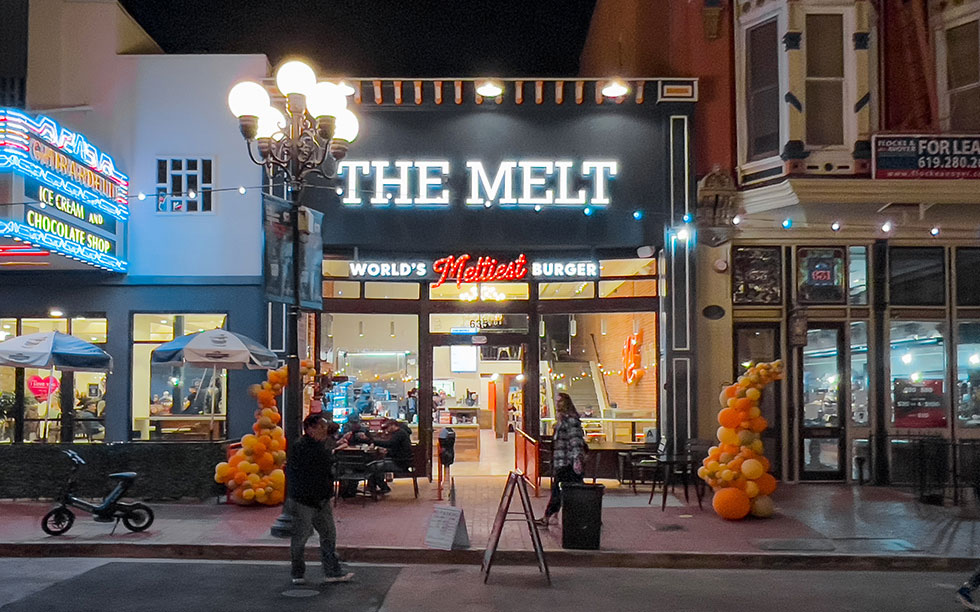
Company-first, then franchise means the restaurants were proven on the franchisor’s capital — the first partners are not paying for the experiment.
The brand has a few restaurants, a deck, and a development schedule. The first franchisees pay for the learning curve: the kitchen that still needs a rewrite, the labor model that only works on paper, the trade areas that looked fine from a spreadsheet. That is a legitimate way to grow. It is also a specific kind of risk, and experienced multi-unit operators know it when they see it.
There is another sequence. Build the restaurants with company capital. Run them long enough that the numbers are not a launch-year story. Then open franchising as a way to put the brand in markets the company cannot reach as fast — not as a way to raise the money to find out whether the restaurants work.
The Melt took the second path.
The brand spent years as a company-owned system in California and Arizona before Melt Franchising LLC offered franchises in 2026. Company restaurants are still opening in those two states. Franchising is not a substitute for company development. It is additive. That single fact changes the conversation a serious operator should have with any young brand.
Ralph Bower has been direct about the decision. In 1851 Franchise’s coverage of Greg Vojnovic joining the company, Bower said there was no assumption that franchising was the next step. Great food alone is not enough. The company went through the operations, the culture, and the economics first. Vojnovic spent months on a consulting engagement before the role became permanent. That is the opposite of a brand that decides to franchise and then hires someone to explain the restaurants.
If the franchisor is still putting its own money into new restaurants, the operating standard has to work without a franchisee’s balance sheet underneath it. The labor model, the menu, the delivery mix, and the late-night daypart were not designed for a pitch. They were designed because the company had to live with them.
The company plan is still aggressive in California and Arizona. 1851 reported the San Marcos opening as the 20th restaurant and an SFO airport location in the same growth year. Franchising exists because, as Vojnovic told 1851 about Las Vegas, the company cannot open faster than it already is and still defend markets beyond those two states. Partners are not being asked to replace company capital. They are being asked to help protect geography the company cannot reach on its present capacity.
QSR Magazine’s Ben Coley described the 2026 launch as the step taken after a decade of sales growth — not the step taken instead of proving the restaurants. Leadership is explicit about the pace: slow is smooth, and smooth is fast. The system is not trying to win a race for signed agreements. It is trying to place restaurants with operators who already know how to run high-volume rooms.
That is why the minimum is five restaurants and why territories are awarded against a plan, not against a vacant end-cap. A founding partner in this kind of system is not buying a theory. They are buying a transfer of a company operating culture into a new geography.
Bower’s line in that same 1851 coverage is the filter: this is not about selling out the map. A disciplined, operator-first approach means the first three to five franchise groups are a team, not a quota. Vojnovic has said publicly that what matters is building that first group of operators who already run high-performing restaurants — people with a maniacal focus on operations, not a maniacal focus on collecting territories.
The 2026 FDD is the document of record for financial performance. Item 19 reports results for the 14 traditional company-owned restaurants that had a full year of 2025 operations. Those restaurants averaged more than $3.4 million in annual sales, with median sales by third of about $4.75 million, $3.02 million, and $2.02 million, and average prime cost of 55.1%. The FDD counted 18 restaurants at year-end 2025. As of September 2026 there are 24 company-owned restaurants open. Those are three different measurements. A brand that is willing to keep them labeled is usually a brand that is not asking you to confuse current system size with the Item 19 set.
There is a second implication for operators who have been franchisees before. The people running The Melt have signed both sides of the paycheck. CEO Ralph Bower, Head of Franchising Greg Vojnovic, and COO John Morlock have all been operators. That does not make the restaurants automatic. It does mean the franchisor side of the table knows what a missed labor week feels like.
Company-first is not a moral argument. It is a risk argument. If you are adding a concept to a portfolio that already works, the question is whether the brand needed your capital to discover itself. The Melt did not. The open question — the one a Discovery Day and a map are for — is whether your markets produce enough of the same kind of trade areas the company restaurants already occupy.
That is a better first conversation than a tour of a prototype that has never had to carry a P&L.