
Most second-concept conversations start with AUV.
Serious multi-unit operators start with labor.
A brand can post impressive volumes and still be the wrong addition if it requires a different staffing culture, a larger crew, or a production system your existing GMs cannot absorb. The expensive mistake is not missing a high-volume concept. It is adding one that makes the rest of the portfolio harder to run.
That is the test The Melt was built to pass.
A production system with three engines
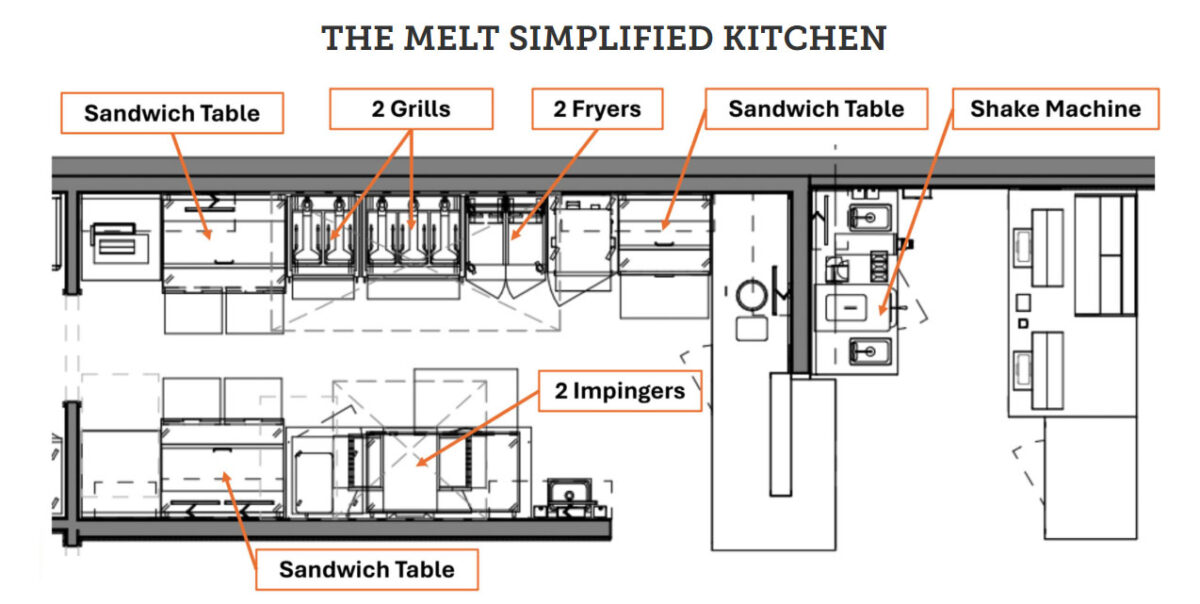
The kitchen is intentionally narrow. Three primary production engines carry the menu: clamshell grills, fryers, and impingers. The footprint is 1,900–2,300 square feet. There is no drive-thru to staff, no sprawling expo line, and no separate concept-within-a-concept.
In a well-run restaurant, the design target is a tight crew — as few as four people on the floor including the manager. That is not a marketing line and it is not a promise for every volume band or every hour. It is the operating intent: high throughput from a focused station layout, not from adding bodies.
Operators who already run disciplined QSR and fast-casual systems recognize this immediately. The playbook looks familiar. The complexity does not.
Why labor design matters more at night
A simple kitchen is useful at lunch. It becomes decisive after 8 p.m.
In strong Melt locations, late-night is often 38–40% of sales, with top units open until 2 a.m. or later. Delivery is a durable share of the business, not a pandemic leftover. You cannot capture that daypart if the labor model falls apart when the second shift clocks in.
A compact production system lets experienced operators extend hours without building an entirely different restaurant after dark. That is incremental revenue. It is also a staffing problem most burger and chicken concepts never really solve.
The numbers behind the design
Company-owned restaurants average $3.4 million-plus AUV. The top third exceeds $5.0 million. Prime costs sit at 55.1%, with cost of goods at 29.6% and labor at 25.5%. Those figures are from restaurants operating in competitive California and Arizona trade areas — not from a single flagship.
The point is not that every franchise location will match the system average. The point is that the labor and kitchen model was pressure-tested in company stores before anyone was asked to buy a franchise.
Who this is for
We designed the franchising program for operators who already protect labor like a P&L line, not a slogan. If you have built a system that runs clean at volume, you will understand why we refused to add stations, prototypes, and dayparts that would break that discipline.
We are selectively awarding protected territories. Qualifying early partners receive a 50% royalty reduction through June 2028 on the first term.
If you are evaluating a second or third concept and the first question you ask is “what does the crew actually look like at 9 p.m.,” we should talk. Visit meltfranchising.com or reach out directly.
Financial performance representations in Item 19 of the The Melt’s 2026 Franchise Disclosure Document are based on company-owned restaurants only. Other than representations made in Item 19, we do not make any representations about a franchisee’s future financial performance or the past financial performance of any company-owned or franchised outlets. We also do not authorize our employee or representatives to make any such representations either orally or in writing. If you are purchasing an existing outlet, however, we may provide you with the actual records of that outlet. If you receive any other financial performance information or projections of your future income, you should report it to the franchisor’s management by contacting Greg Vojnovic, VP and Head of Franchising, 925 Market Street, San Francisco, California 94103, telephone 877-250-6358, the Federal Trade Commission, and the appropriate state regulatory agencies.
Company Name: Melt Franchising, LLC
Address: 925 Market Street, San Francisco, CA 94103