
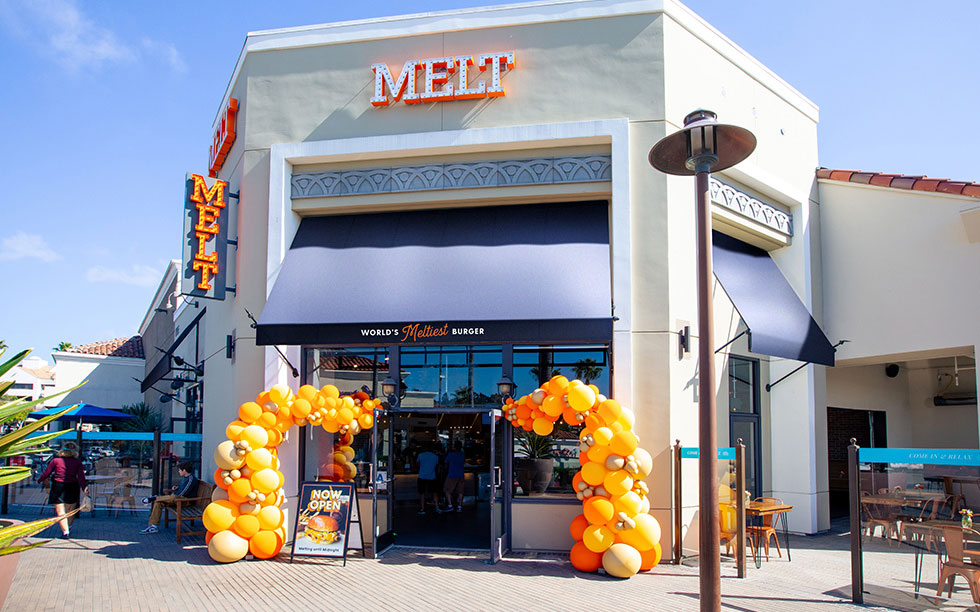
A new restaurant franchise earns its first regular guests through local store marketing, not national awareness. For The Melt, that means marketing the occasions the restaurant already owns, late night and off-premise, inside the trade areas that were graded before the lease was signed. The 2026 FDD sets advertising at 2.5 percent of gross sales, and the 0.5 percent local advertising minimum is part of that 2.5 percent, not on top of it.
Operators adding a second or third brand can request franchise information here.
Key facts
- Who this is for: Multi-unit and multi-brand operators opening a concept the market has not seen
- Local marketing focus: After-8 p.m. and off-premise occasions, inside graded trade areas
- Company mix, labeled: In well-placed company restaurants, sales after 8 p.m. are often 38 to 40 percent of the day, and off-premise, including third-party delivery, is about 40 percent of sales
- Fees (2026 FDD): Royalty 5 percent; advertising 2.5 percent of gross sales, which includes the 0.5 percent local advertising minimum (not additional)
- Minimum commitment: Five restaurants is the standard. Three-restaurant agreements for smaller markets are under consideration; operators contact Greg Vojnovic directly
- Item 19 sample: 14 traditional company-owned restaurants with a full year of 2025 operations; average sales of more than $3.4 million
- Restaurant counts, labeled: 14 in the Item 19 sample; 18 at year-end 2025 in the FDD (17 traditional and 1 non-traditional); 24 company-owned as of September 2026
Can a new restaurant brand build local awareness without national advertising?
Yes, but the first restaurants in a market do the work themselves. A national fund cannot do it for them.
Multi-brand operators know this. The Melt will arrive in a new market as a premium burger-and-melts restaurant, with company restaurants as proof, a late-night daypart most competitors under-serve, and a delivery mix that holds up when the food is built to travel. Local store marketing is how those facts become a habit.
Which occasions should a new Melt restaurant market first?
After 8 p.m. and off-premise. Lunch and early dinner are table stakes in burger. The wedge is the rest of the day.
In well-placed company restaurants, sales after 8 p.m. are often 38 to 40 percent of the total. Off-premise, including third-party delivery, is about 40 percent of sales. The channel is covered in How The Melt Built a Delivery Business That Actually Works, and this post does not repeat it.
Entertainment corridors, shift change, hotel density and the last delivery window before midnight are the demand the kitchen was built to catch. They deserve the same planning as Saturday lunch.
Does delivery help a brand nobody knows yet?
It can, if the order is right. A new restaurant will not outspend a national chicken brand on billboards in month one. It can beat a tired late-night menu on the delivery apps when the order is accurate, the food arrives intact and the name is easy to repeat.
The Stanford-area company restaurant that generated more than $6.1 million in annual sales did nearly 40 percent of that volume through delivery. That is one restaurant, not an average and not a franchise forecast.
How should multi-brand operators use the guest file they already have?
Carefully. An operator who runs chicken, sandwiches, coffee or tacos in the same market already has guests who drive the corridors the new restaurant will sit on.
The Melt wants to be the second kind of brand, the one that adds a night rather than taking one.
"A second brand that competes for the same ticket raids your guests. One that gives them a different night and a different meal is a referral. We're meant to be the second kind," says Greg Vojnovic, VP and Head of Franchising at The Melt. The sandwich case is laid out in Same Footprint, Different Night.
What is the 0.5 percent local advertising minimum for?
It is meant to be spent inside the trade area, not across a county. The 2026 FDD sets advertising at 2.5 percent of gross sales, and the 0.5 percent local minimum is part of that 2.5 percent, not an addition to it. Royalty is a separate 5 percent.
The local dollars should follow the map that was already drawn: campus media, venue partnerships, hotel concierges and apartment density inside the drive-time ring. A county-wide spray treats a B trade area as if it were an A. The Melt grades trade areas on drive time, not a fixed mile radius, and the logic is in Plan-Led vs. Broker-Led: How Serious Operators Should Choose the First Five Trade Areas.
The same logic applies to smaller markets. The Melt's leadership team knows that a market can have attractive trade areas and still not enough population for five restaurants. For those smaller DMAs, the company is considering three-restaurant development agreements, shaped market by market with the franchisee. In a market like that, a tight local plan matters more, because there are fewer restaurants to carry the awareness. Operators interested should contact Greg Vojnovic directly.
What does the food have to prove in the first thirty days?
Everything else. Do not ask the food to be a mascot. The MeltBurger, the melts, the crispy chicken, the mac & cheese and the shakes are the product, made with all-natural ingredients and no artificial colors or flavors. Photograph the food. Serve the food.
VinePair's Yelp-based analysis already put The Melt among San Francisco's highest-rated burger restaurants. That is useful social proof for the first search. It does not replace a clean first thirty days of orders.
What should an operator measure in the first month?
The same things a P&L would show. Weekly sales by daypart, delivery order accuracy and repeat orders tell an operator more than a follower count does.
The company's guest standard is a Yelp review at the Stanford restaurant that read "I love it here," and the test for a new restaurant is whether an order makes someone say it. The late-night and delivery mix should show up in the weekly numbers before an operator buys more media.
What does the franchisor supply, and what does the operator supply?
The Melt supplies the brand, the playbooks and restaurants that already proved the mix. The operator supplies the local plan that makes the second, third and fifth guest show up without a national campaign.
Operators who already do that for another brand will find this familiar. Operators who expect the national fund to create demand should read the fee disclosures in the FDD again before signing a five-restaurant agreement, and request franchise information if the local plan makes sense for their portfolio.
FAQ
How do you market a new franchise restaurant with no national awareness?
Market the occasions the restaurant already owns. For The Melt, those are evening, late night and off-premise. Use the delivery platforms guests already open, refer guests from the operator's other brands without raiding the same ticket, and spend the local advertising minimum inside the graded trade area.
What are The Melt's advertising fees?
In the 2026 FDD, advertising is 2.5 percent of gross sales, and the 0.5 percent local advertising minimum is part of that 2.5 percent, not in addition to it. Royalty is a separate 5 percent. Read the FDD for the full fee schedule.
Can an existing restaurant operator market The Melt to its current guests?
Yes, with care. The test is whether the second brand gives guests a different night and a different meal, which makes it a referral, or competes for the same ticket, which raids the operator's existing guests.
How many restaurants does The Melt require?
The standard development agreement is five restaurants. For smaller DMAs with attractive trade areas but limited population, The Melt is considering three-restaurant agreements, shaped market by market with the franchisee. Interested operators should contact Greg Vojnovic directly at 877-250-6358.
Request franchise information to see whether a five-restaurant agreement fits your portfolio.
Financial performance representations in Item 19 of the The Melt’s 2026 Franchise Disclosure Document are based on company-owned restaurants only. Other than representations made in Item 19, we do not make any representations about a franchisee’s future financial performance or the past financial performance of any company-owned or franchised outlets. We also do not authorize our employee or representatives to make any such representations either orally or in writing. If you are purchasing an existing outlet, however, we may provide you with the actual records of that outlet. If you receive any other financial performance information or projections of your future income, you should report it to the franchisor’s management by contacting Greg Vojnovic, VP and Head of Franchising, 925 Market Street, San Francisco, California 94103, telephone 877-250-6358, the Federal Trade Commission, and the appropriate state regulatory agencies.
Company Name: Melt Franchising, LLC
Address: 925 Market Street, San Francisco, CA 94103